Worried About Money?

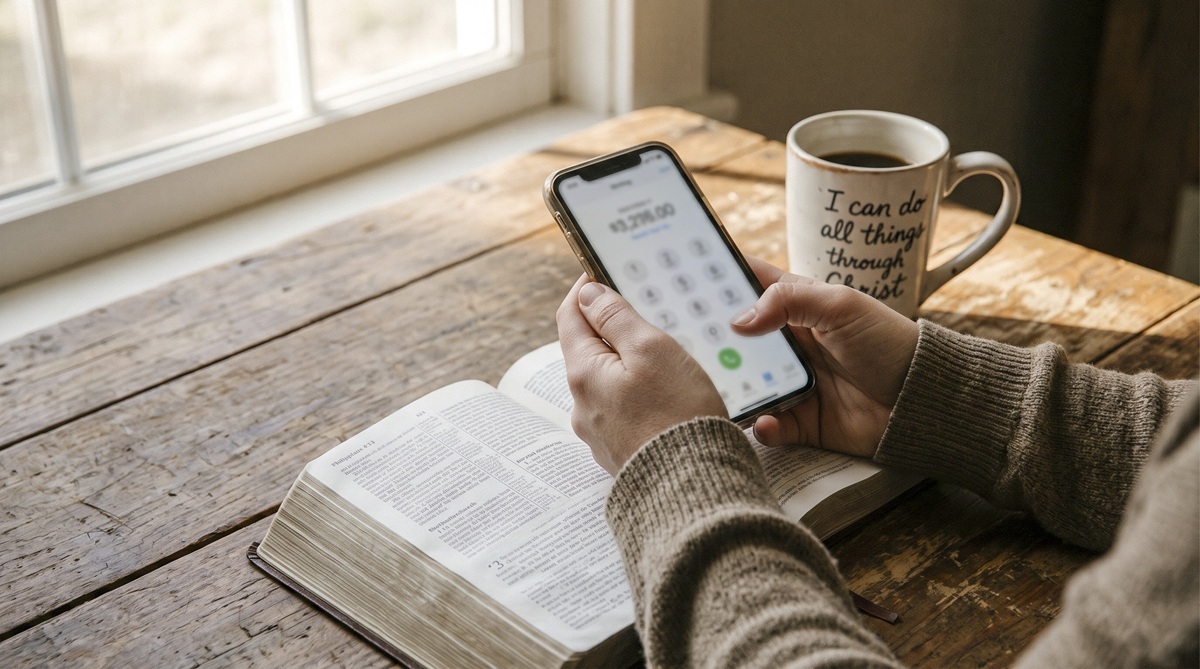
A few years ago, I dropped my boys off at school and stopped at the gas station like I did most mornings. I was usually out the door before breakfast, so the stop had become a habit. I set my food on the counter and swiped my card.
Declined.
I swiped again. Declined. If you’ve ever stood at a register with your breakfast in front of you and a line forming behind you, you know that feeling. I walked out to the car, opened the bank app, and my stomach dropped. Someone had drained thousands of dollars from our account and was still trying to take more.
It turned out a man across the country had gotten hold of a list of account numbers, and ours was on it. The bank made everything right. But something in me changed that morning. For a long time afterward, I wondered at every register whether the card would go through. I started checking my balance all the time.
Maybe you know that habit. When the number is healthy, life feels good. When it’s low and the bills are due, the whole day turns gray. It’s remarkable how much a number on a screen can decide how we feel.
Here’s what I eventually had to admit: the problem was never in the bank. It was in my heart. I had put my trust in what I could see, what I could count, and what I could control. When the account slipped out of my hands, so did my peace.
We all have that bent. We want everything under our thumb, and we tie our peace to whatever we can see. So the real question isn’t how much is in the account. It’s this: What are you trusting to take care of you?
Paul answered that question from a prison cell.
Philippians 4:13 Was Never a Bailout Verse
When Paul wrote to the Philippians, he was chained in a Roman prison. He was a tentmaker with no tents to sell, no income, and no way to provide for himself. Rome didn’t care whether he ate.
From that cell, he wrote one of the most quoted verses in the Bible:
“I can do all things through Christ which strengtheneth me.”
— Philippians 4:13
We love that verse. We put it on coffee mugs and athletes’ eye black. But we usually lift it out of its setting. Read the two verses just before it:
“Not that I speak in respect of want: for I have learned, in whatsoever state I am, therewith to be content. I know both how to be abased, and I know how to abound: every where and in all things I am instructed both to be full and to be hungry, both to abound and to suffer need.”
— Philippians 4:11–12
Paul isn’t talking about winning the game or landing the job. He’s talking about being content whether he’s full or hungry, whether he has plenty or nothing at all. The “all things” of verse 13 are the circumstances of verse 12.
This is where many of us get it backward. When the account is full and the bills are paid, it’s easy to drift from Christ, because we don’t feel much need for Him. Then life turns. The diagnosis comes. The job ends. The card gets declined. Suddenly we reach for Philippians 4:13 like an emergency exit.
But that promise came from a man whose contentment was already settled in Christ. Earlier in the same letter he wrote, “For to me to live is Christ, and to die is gain.” His peace rested on a Person, not on his circumstances. That’s why the same chapter can say, just a few verses earlier, “Be careful for nothing.” Paul isn’t telling us to ignore our needs. He’s inviting us to bring them to the One who never runs short.
And he tells us how he got there.
Contentment Is Learned, Not Found
Notice Paul’s word: “I have learned.” Contentment didn’t arrive the day he was saved. It grew over years of trusting God through shipwrecks, beatings, plenty, and want.
That runs against everything our culture teaches. We’re told contentment is one more purchase away. The townhouse with the small yard isn’t enough, so we need six acres and a two-car garage. Then we’ve bought four vehicles, so we need a four-car garage, plus somewhere to park the boat. Then a place on the lake would be nice. Then a place at the beach. It’s never enough, because something sinful in us always wants more for itself.
God’s answer surprises us. He doesn’t say, “Get more and you’ll be satisfied.” He says, in effect, “Give it away, and you’ll find contentment.”
The Philippians proved it. They weren’t a wealthy church. They lived in deep poverty, ordinary working people stretching one paycheck to the next. The church at Corinth had money to spare and didn’t keep its promises. Yet when Paul left Macedonia, the Philippians were the only church that partnered with him:
“For even in Thessalonica ye sent once and again unto my necessity. Not because I desire a gift: but I desire fruit that may abound to your account.”
— Philippians 4:16–17
Once and again. They didn’t give one time and stop. And Paul says their gift was far more than a transaction:
“But I have all, and abound: I am full, having received of Epaphroditus the things which were sent from you, an odour of a sweet smell, a sacrifice acceptable, wellpleasing to God.”
— Philippians 4:18
Most of us give with the click of a button or a check in the plate. Done. Duty finished. But when your gift keeps a missionary on the field, it rises before the Lord as a sweet fragrance. Remember that the next time you click.
Then Paul gives the promise that holds the whole passage together:
“But my God shall supply all your need according to his riches in glory by Christ Jesus.”
— Philippians 4:19
It’s the only future promise in the passage, and it doesn’t say “might” or “maybe.” God shall supply. And notice what He promises: not your wants, not your wishes, but your need.
Now try something with me. Take verse 19 out of the passage. Would you still give?
That question goes straight to the heart. Are we giving so God will fill our account? That’s the prosperity gospel, and it isn’t the gospel. Or are we giving because we’ve tasted the grace of God and want someone else to taste it too? Jesus warned about “the deceitfulness of riches.” The love of money doesn’t only make us greedy. It turns us into getters, while God is looking for givers. He gave, and He’s still giving.
The heart that cannot rest or give has not yet trusted God with its supply.
No one in Scripture shows that trust more clearly than Abraham.
The Open Hand on Mount Moriah
God promised Abraham a son when he was nearly a hundred years old. Isaac was the child of promise, the one through whom God would build a great nation. Then, in Genesis 22, God asked Abraham to offer that son on Mount Moriah.
Abraham “rose up early in the morning.” He didn’t argue. He didn’t stall. He split the wood, saddled the donkey, and started up the mountain. Partway up, Isaac asked the question every reader dreads: Dad, where’s the lamb?
“And Abraham said, My son, God will provide himself a lamb for a burnt offering: so they two went both of them together.”
— Genesis 22:8
Did Abraham know how God would do it? Looking at what he had, the only lamb on that mountain was his own son, the most precious gift God had ever given him. It would have been easy to clench his fist and say, God, You gave him to me. I’m not giving him back.
Instead, Abraham opened his hand. Hebrews tells us he climbed that mountain believing God could raise Isaac from the dead if He had to. At the last moment, God provided a ram caught in a thicket, and Abraham named the place Jehovah-jireh: the Lord will provide.
Abraham was a wealthy man, but his heart didn’t rest on his wealth. He had learned contentment in God over a lifetime of testing, and that contentment made him generous with the one thing he treasured most.
The scene points far beyond Abraham. On Moriah, God provided a substitute. At Calvary, God’s own Son was the substitute. There was no ram in the thicket for Jesus.
“He that spared not his own Son, but delivered him up for us all, how shall he not with him also freely give us all things?”
— Romans 8:32
If God did not hold back His own Son from you, He will not fail you now.
Before You Check the Balance
So let me ask you the question Abraham had to answer: What are you holding so tightly that, if God asked for it, you would tell Him no? It may be money. It may be a relationship, your plans, or your sense of control. Whatever it is, watch the clenched fist.
If you’re new to the faith, be patient with yourself. Contentment is learned. Abraham didn’t reach Moriah in a day, and God grows us one test at a time. But start somewhere. Give Him yourself first, then trust Him with the next step.
If you’ve walked with the Lord for years, take an honest look at your heart. Is your peace resting on Christ, or on a comfortable balance?
Here’s one practice for this week. The next time you open your banking app, stop before you look at the number. Pray simply, “Lord, this is not my provider. You are the One who supplies all my need.” Then look.
And take one step toward an open hand. Choose one missionary, someone your church supports or someone you know personally, and make them your missionary for the next twelve months. Pray for them by name. Write to them. Learn their children’s names. If God leads, give beyond what feels comfortable. That’s how ordinary believers, like those poor Philippians, become partners in reaching the world.
Your bank account can tell you what you have. It will never tell you who has you. Your balance will rise and fall, but the God who supplies all your need has never been overdrawn.
Worry has a way of hiding behind a number.
When the balance drops, fear calls itself “being careful.” Chapter 1 of my book Standing in the Dark, “The Darkness Has Many Names,” helps you call it what it is, and it’s yours free when you join Between Sundays, my email newsletter of Bible teaching for the rest of the week.
Get Chapter 1 Free