Where Are the Nine?

The phone call comes on a Tuesday afternoon. The tests came back, and the doctor didn't like what he saw. Before the day is over, you've called your family. Then you've called your pastor. "Would you pray? Would you have the church pray?"
So the church prays. Your name is lifted up on Sunday morning and again on Wednesday night. Your family prays around the kitchen table. Then the next report comes back clear. Whatever was there is gone.
The first Sunday back, you share the news and the whole room rejoices. You thank God, and you mean every word.
Six months later, your seat is empty. Nobody turned against God. Nobody left angry. Life simply got back to normal, and somewhere in the normal, the thanks went quiet.
I've watched that happen in other people's lives. I've watched it happen in my own. And Jesus has a question for every one of us in that moment. It's tucked into one of the shortest miracle accounts in the Gospels.
Where Are the Nine?
In Luke 17, Jesus is walking a dusty road between Samaria and Galilee when ten lepers meet Him. They stand "afar off," just as the law required. Leprosy in Bible times was a slow, disfiguring disease. It took fingers, faces, and futures. It was also a lonely disease. A leper had to call out a warning to anyone who came near, so these ten had been cut off from home, from family, and from worship. They had banded together because no one else would have them.
They lift up their voices: "Jesus, Master, have mercy on us." Jesus doesn't touch them. He doesn't heal them on the spot. Instead, He gives them something to do.
And when he saw them, he said unto them, Go shew yourselves unto the priests. And it came to pass, that, as they went, they were cleansed. (Luke 17:14)
All ten obey. Somewhere on that road, all ten are healed. And then the story turns.
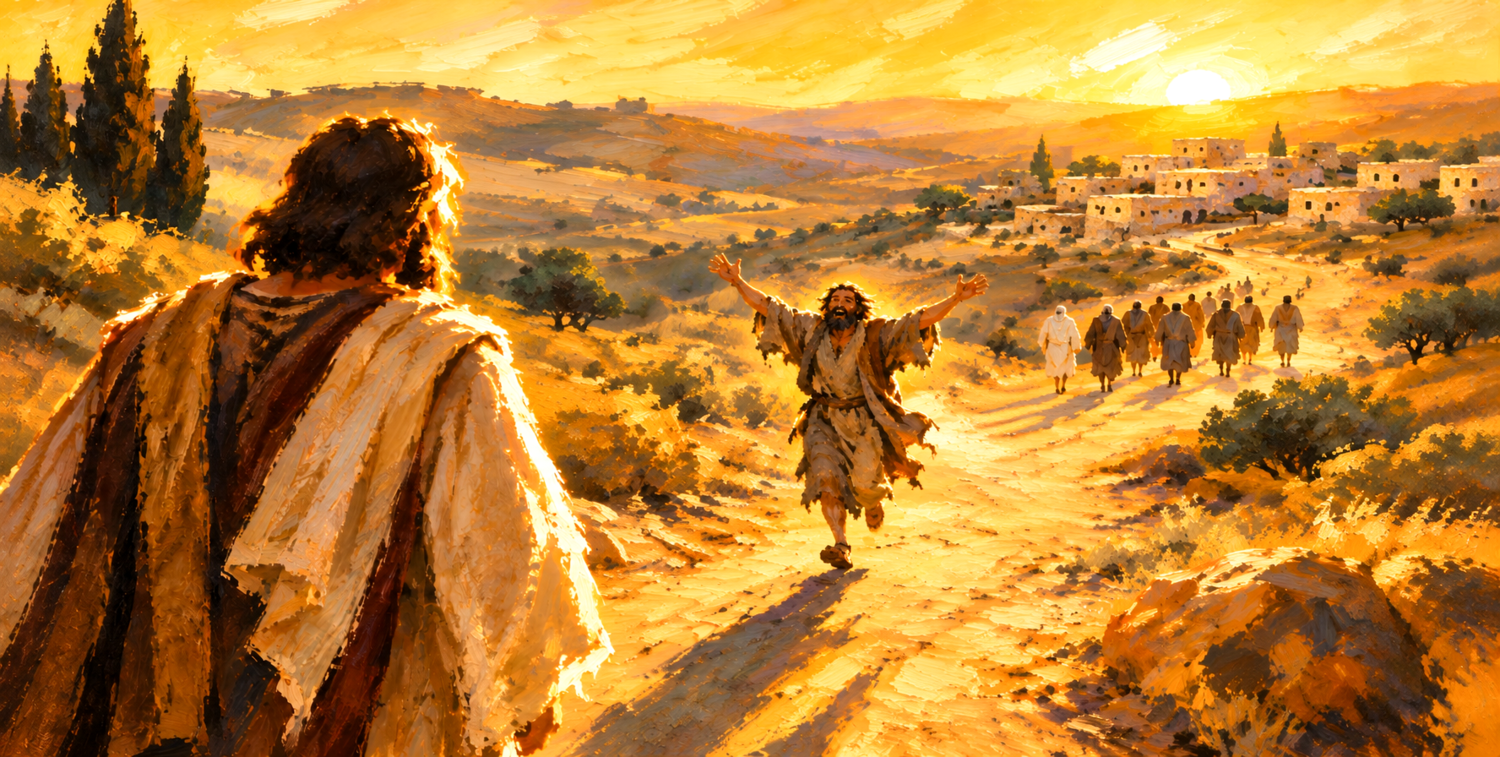
And one of them, when he saw that he was healed, turned back, and with a loud voice glorified God, and fell down on his face at his feet, giving him thanks: and he was a Samaritan. (Luke 17:15–16)
One turned around. Just one. Then Jesus asks the question that ought to stop every one of us in our tracks:
Were there not ten cleansed? But where are the nine? (Luke 17:17)
That's the gratitude gap. It's the distance between what God has done for us and how often we come back to Him with real thanks.
We don't struggle to call on God when life falls apart. We're not shy about it, and we shouldn't be. But when the answer comes, a quick "Thank You, Lord" is often all we give before we keep walking the way we were already going.
Most of us would like to think we're the one who ran back. Look a little closer, though. Most of us look a lot more like the nine.
This isn't a question about God's goodness. God is good, and He was good to all ten. The question is about our response. Moses warned Israel about this very danger centuries before Jesus walked that road:
When thou hast eaten and art full, then thou shalt bless the LORD thy God for the good land which he hath given thee. Beware that thou forget not the LORD thy God. (Deuteronomy 8:10–11)
Healed, but Not Whole
So what did the one find that the nine missed? Look at how the story ends. All ten were cleansed. Only one heard these words:
And he said unto him, Arise, go thy way: thy faith hath made thee whole. (Luke 17:19)
The nine went on to the priests. They were likely declared clean and sent home to their families, and there's nothing wrong with that. It was a real healing and a real restoration. But Scripture records only one man made whole, and he was the one lying at the feet of Jesus.
Wholeness wasn't found when they first met Jesus. It wasn't found in the healing itself. It was found when a grateful man came back and fell on his face before the One who healed him.
Grace reached all ten. Jesus healed every one of them. But one man responded in faith and came back to the Giver, not just the gift.
For by grace are ye saved through faith; and that not of yourselves: it is the gift of God. (Ephesians 2:8)
The healing was the invitation. Every answered prayer, every clear report, every need met when you couldn't see a way, is a signpost pointing back to God.
Every good gift and every perfect gift is from above, and cometh down from the Father of lights, with whom is no variableness, neither shadow of turning. (James 1:17)
Too often we read the signpost and never follow it. We enjoy the gift and forget the Giver. Can a believer receive God's blessing without ever fully returning to Him? The nine tell us yes.
If you know Christ as your Savior, hear this clearly: your salvation is secure. Drifting doesn't undo what Jesus finished on the cross. But the nine show us a pattern we can slip into, where we enjoy everything God gives while losing the closeness of being at His feet.
When Religious Duty Becomes the Destination
Here's what makes the nine so sobering: they weren't rebels. They obeyed. They were doing exactly what they'd been told and heading exactly where they'd been sent. Going to the priests wasn't wrong. Jesus Himself sent them there.
The problem was that the religious duty became the destination. They kept walking toward the routine and never turned toward the Person who had just changed their lives.
That's where many faithful believers live. We serve. We attend. We do the right things. And slowly, almost without noticing, we grow quieter in our thanks. Our walk with Christ becomes routine, then mundane. Years removed from the day He saved us, we forget how much He has done, and gratitude that once came easily gives way to complaint.
Scripture places ingratitude near the root of humanity's turn away from God:
Because that, when they knew God, they glorified him not as God, neither were thankful; but became vain in their imaginations, and their foolish heart was darkened. (Romans 1:21)
Saved people still have flesh, and the flesh loves to take the credit. Thankfulness pushes back against that pull. That's one reason God calls us to give thanks again and again. Every time we turn back to thank Him, we're drawn a little closer.
Draw nigh to God, and he will draw nigh to you. (James 4:8)
A grateful heart is a returning heart, and a returning heart is a growing one. Spiritual growth isn't measured by how much God has given us. It's measured by how often His gifts bring us back to Him.
A Good King Who Drifted
If you think drifting only happens to weak believers, consider Hezekiah. He loved the Lord. He knew the law. Under his leadership, Judah saw revival. When Assyria swept away the northern kingdom and laid siege to Jerusalem, God spared the city.
Then Hezekiah fell deathly ill. The prophet Isaiah brought hard news: set your house in order, because you're going to die. Hezekiah turned his face to the wall and wept before the Lord. Isaiah hadn't even made it out of the palace courtyard before God sent him back. The Lord had heard. He added fifteen years to Hezekiah's life.
That's an answered prayer and a miraculous healing. And Hezekiah was grateful, just as we would be. But Scripture tells us what came next:
But Hezekiah rendered not again according to the benefit done unto him; for his heart was lifted up: therefore there was wrath upon him, and upon Judah and Jerusalem. (2 Chronicles 32:25)
The healing became something to display instead of a reason to return. His gratitude faded, and pride moved into the space it left. If a king like Hezekiah could drift, any of us can.
Thank God, that isn't the end of his story.
Notwithstanding Hezekiah humbled himself for the pride of his heart, both he and the inhabitants of Jerusalem, so that the wrath of the LORD came not upon them in the days of Hezekiah. (2 Chronicles 32:26)
Hezekiah saw how far he had drifted. He humbled himself, and he came back. It wasn't too late for him. It isn't too late for you.
Turn Around
So how do you turn around? Start with one honest question: When was the last time an answered prayer sent you back to His feet before it sent you back to your routine?
Remember who it was that came back. He was a Samaritan, an outcast and a stranger. The priests wouldn't have welcomed him. Jesus did. No one is beyond the reach of grace, and no one has drifted too far to come home.
Remember, too, how he came back. He came with a loud voice, glorifying God, and everyone he passed on that road knew what Christ had done for him. Gratitude isn't a feeling or a mood. It's an act of worship, and it was never meant to be kept quiet.
This week, try this:
- Name it. Think of one thing God has done for you recently. Not years ago. Pick the prayer He answered, the report that came back clear, or the need He met when you couldn't see how.
- Return with it. If you haven't come back to thank Him for it, don't wait. Go to Him today and give Him the thanks He deserves. He's full of mercy, and He's waiting for you.
- Say it out loud. Thanksgiving is coming, and you'll be sitting at a table with people who need to hear it. Tell them what God has done. Yes, they might look at you. That's the point. They need to see Christ in someone they know.
Ten cried out. Ten received mercy. Ten were cleansed. Only one returned. This Thanksgiving, be the one.