Surrender Isn’t Losing

You've seen it happen. It's the fourth quarter, the scoreboard is lopsided, and everyone in the stadium knows how this one ends. Somewhere along the way, the losing team stops fighting. The tackles get softer. The hustle disappears. They're still on the field, but they've quit.
That's the picture most of us carry when we hear the word surrender. A white flag over a battlefield. A team that gave up. The losers.
We don't like that word. We were raised to keep swinging, never quit, and come out on top. So it's uncomfortable to open the Bible and find that the very thing we resist most is the very thing God always starts with.
In 2 Corinthians 8, Paul tells the story of a group of churches that surrendered first and then did something that still astonishes readers two thousand years later. Their story holds a truth every believer needs: partnership starts with surrender. When God has you first, His grace will take you, and your giving, further than you could ever go on your own.
Surrender Comes Before Supply
Take an honest look at your prayer list right now.
For many of us, it reads like a supply order. Lord, I need tires on the truck. I need this bill paid. I need the money to cover this, and this, and this. We ask. We ask again. And we wonder why the answer seems so slow.
If that's where you are, you're not alone, and those prayers aren't wrong. God invites us to bring Him our needs. But 2 Corinthians 8 shows an order we tend to skip. Before God's grace overflowed through the Macedonian believers, something else came first:
"And this they did, not as we hoped, but first gave their own selves to the Lord, and unto us by the will of God."
2 Corinthians 8:5
First gave their own selves. Surrender comes before supply.
When we haven't settled who sits on the throne of our hearts, giving turns into one of two things. Sometimes it becomes a burden we resent. The offering plate comes by and we think, You don't know my bank account. You don't know what bills I have this week. Other times it becomes a badge we wear: Let me show you how much I gave.
Neither is biblical. Both come from the flesh, and the flesh always asks, What can I afford? God asks something different: Who do you belong to?
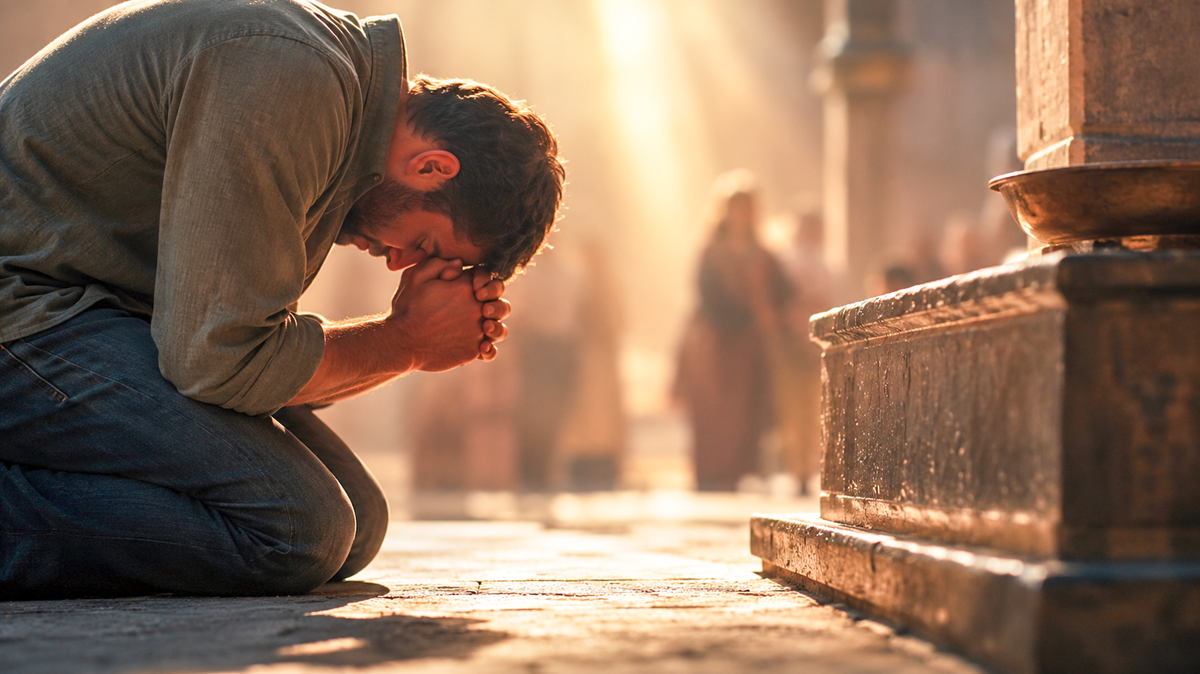
Growth in generosity doesn't start with a budget. It starts at the altar, on your knees before the God of the universe, saying, "Here am I."
The Poor Church That Begged to Give
Paul didn't leave that truth abstract. He pointed the Corinthians to two churches, side by side.
His first letter to Corinth had been a hard one. The church was divided into factions, tolerating sin, and mishandling the Lord's Table. His correction created friction, and his second letter was partly an effort to mend the relationship.
There was also unfinished business. The Corinthians had pledged to help Jewish believers in Jerusalem who were suffering through famine. Corinth could easily afford it. It was a wealthy trade city, and the church had plenty.
They just hadn't followed through.
A few hundred miles north, the churches of Macedonia lived in a different world:
"How that in a great trial of affliction the abundance of their joy and their deep poverty abounded unto the riches of their liberality."
2 Corinthians 8:2
These believers were persecuted and poor. They lived day to day, working to put food on their own tables. Yet they had already given so that believers they'd never met would have food on theirs.
And they didn't give reluctantly. Paul says they were "praying us with much intreaty that we would receive the gift" (v. 4). They were begging him to take their money.
In thirteen years of pastoring, exactly one person has come to me and said, "Pastor, please take my money." People give. But we rarely come with the heart that says, Lord, everything I have is Yours.
The rich church hadn't given. The poor church couldn't be stopped. The difference wasn't money. It was surrender.
Once God Owns the Giver, the Gift Is Just Details
So where did that kind of surrender come from? Look at how the passage begins. Verse 1 speaks of "the grace of God bestowed." Grace comes first. Always.
We don't work up God's grace or earn it. It's His gift, and the gospel is the clearest picture of it:
"For God so loved the world, that he gave his only begotten Son, that whosoever believeth in him should not perish, but have everlasting life."
John 3:16
Paul's description of the Macedonians in verses 3 through 5 is one long sentence, and at its center sits one verb: gave. The whole Christian life is built on that word. God gave. Christ gave Himself. And people who understand that grace find themselves giving in return.
That's because surrender settles ownership. When you grasp what Christ did for you, surrender isn't handing over something that was yours. It's agreeing with what's already true. David put it this way:
"For all things come of thee, and of thine own have we given thee."
1 Chronicles 29:14
Once ownership is settled, giving stops being only about money. Paul calls us to a life that is itself an offering:
"I beseech you therefore, brethren, by the mercies of God, that ye present your bodies a living sacrifice, holy, acceptable unto God, which is your reasonable service."
Romans 12:1
A living sacrifice gives time, talent, and treasure. Every hour you serve, every conversation where you share Christ, every quiet act of faithfulness is an offering that flows from a heart that's fully His.
This is also where coasting gets exposed. Plenty of people say, "I belong to Christ," yet their lives don't show a surrendered heart. They haven't lost their salvation. They've settled into cruise control, hoping to make it to the end. God didn't call us to coast. He called us to live in a way that tells everyone around us: I have surrendered all.
Once God owns the giver, the gift is just a matter of details.
Rich Through His Poverty
Paul saves his strongest argument for last. He points past the Macedonians to the One they were following:
"For ye know the grace of our Lord Jesus Christ, that, though he was rich, yet for your sakes he became poor, that ye through his poverty might be rich."
2 Corinthians 8:9
Here's something easy to miss in English. The word for poverty in verse 9, describing Christ, is the same Greek word Paul used in verse 2 for the Macedonians' deep poverty.
That's no accident. Their poverty had become a reflection of their Savior's. He became poor to make them rich, and in their poverty they made others rich. Christ is both the pattern for surrendered giving and the power behind it.
Think about His earthly ministry. He had nowhere to lay His head. When the temple tax came due, He and His disciples didn't have the money, so He sent Peter fishing, and the coin was in the fish's mouth (Matthew 17:24–27). He didn't worry, because He trusted the Father completely.
Should we worry about our bills? Scripture says no. Do we still pay them? Of course. But a surrendered heart sees every need through the lens of what Christ has already done.
Let me be clear: this is not a prosperity promise. Surrender doesn't guarantee God will make you rich. It promises that His grace will carry your giving further than you could ever carry it yourself.
Most of us will never move to Poland, Indonesia, or the Dominican Republic as missionaries. But the gifts our church sends to missionaries in Poland are there right now, keeping them on the field and funding Bible studies, children's programs, and youth ministry. We stay where we are. We give. We surrender. God does the rest. The reward isn't a bigger bank account. It's eternal fruit:
"Not because I desire a gift: but I desire fruit that may abound to your account."
Philippians 4:17
And God measures the gift by the heart, not the amount:
"For if there be first a willing mind, it is accepted according to that a man hath, and not according to that he hath not."
2 Corinthians 8:12
Jesus once sat in the temple and watched people bring their offerings. The wealthy dropped in large sums, and He said nothing. Then a widow put in two small coins, and He called His disciples over:
"Verily I say unto you, That this poor widow hath cast more in, than all they which have cast into the treasury: For all they did cast in of their abundance; but she of her want did cast in all that she had, even all her living."
Mark 12:43–44
The issue was never the amount. It was always surrender.
Where Do You Start?
Every so often, someone offers to donate clothes to the church for families in need. Sometimes the box arrives full of shirts with holes, paint stains, and a few weeks of wear. I was getting rid of these anyway. Maybe the church can use them.
If we're honest, that's often how we treat God. He gets the leftovers of our time, our money, and our attention. But He isn't asking for leftovers. He's asking for you.
So where do you begin?
If you're new in your faith, start small, but start with your whole heart. Give willingly and trust Him. You'll discover the joy of giving and see how much grace He has already poured out on you.
If you've walked with Christ for years, ask yourself honestly: Have I stopped giving? And if so, is it because I've stopped surrendering? If that's you, come back to the altar. Tell Him again that He is Lord of your life and King of your heart. Give Him your time, your talent, and your treasure.
If you've never trusted Christ, God isn't asking for your money. He's offering you His Son, who gave His life for you. Surrender isn't how you get saved. Christ already did everything needed for that. Surrender is how a saved person lives. Your starting point is to believe in Him and receive Him. Everything else follows.
Before your next offering, your next commitment, or your next act of service, settle first things first. Paul's words to the Corinthians are God's words to us:
"Therefore, as ye abound in every thing, in faith, and utterance, and knowledge, and in all diligence, and in your love to us, see that ye abound in this grace also."
2 Corinthians 8:7
Remember the white flag? There was another surrender, on a hill outside Jerusalem. The Son of God, who owned everything, surrendered Himself to the Father's will. No one took His life. He laid it down. He didn't lose that day. The greatest victory in all of eternity was won.
Because He surrendered for you, you can surrender to Him. The world has it wrong. In God's kingdom, surrender isn't the end of the fight. It's the beginning of a great partnership.
Have you given yourself to Him first?