You Didn't Choose This Church — God Did

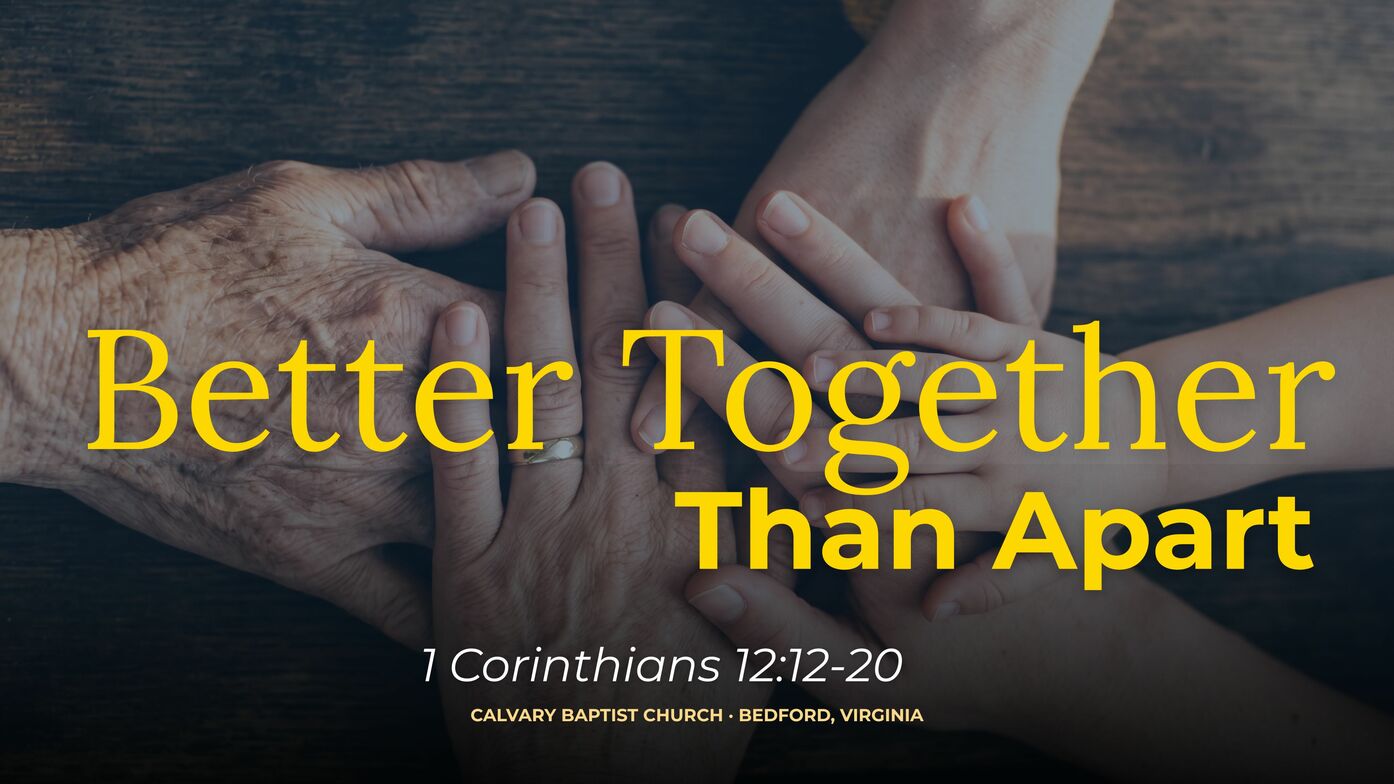
My father used to say that the hardest conversations are the ones worth having. Most families know the feeling — everyone around the table, the tension just beneath the surface, and somebody finally deciding it's time to say what needs to be said. Not to wound. Not to win. Just to clear the air so everyone can move forward together.
The church is no different. The Holy Spirit moved through Paul's first letter to the Corinthians precisely because that congregation needed a hard family conversation. They were gifted, Spirit-filled, and deeply divided — fractured along lines of personality, preference, and pride. Into that mess, the Holy Spirit delivered one of the most clarifying images in all of Scripture: the human body.
It's a picture every person understands. And once you see it, you can't unsee it.
You Didn't Choose This Church — God Did
In an age of consumer Christianity, there is a quiet temptation to treat church membership as we do a subscription service — useful until it no longer meets our needs, then canceled in favor of something that fits better. The Spirit dismantles that framework in a single verse.
"But now hath God set the members, every one of them in the body, as it hath pleased him." — 1 Corinthians 12:18
That word set carries the weight of something deliberate, completed, and personal. God didn't suggest you attend this church. He placed you here — with intention, with purpose, and with full knowledge of who else He was placing alongside you.
Your membership in the body of Christ is not the result of a preference survey. You are not here because the parking was convenient, the music suited your taste, or a sermon happened to land on the right Sunday. You are here because God, in His sovereignty, put you here.
And that truth cuts in every direction. The older member who longs for what the church used to be — God placed them here. The young couple with the big vision and the restless energy — God placed them here, too. The person whose preferences try your patience — God looked at this body and said, I need that person here. Which means He said the same thing about you.
That changes everything.
The Church Wasn't Meant to Look Like You
A particular kind of church conflict disguises itself as principle when it is actually preference. Comfort zones get dressed in theological language and are called convictions. Nostalgia gets called faithfulness. Restlessness gets called vision. And the body keeps tearing itself apart while everyone insists they're standing on something that matters.
The Spirit's answer in 1 Corinthians 12 is so simple it almost sounds dismissive — until you sit with it long enough.
"For the body is not one member, but many. If the foot shall say, Because I am not the hand, I am not of the body; is it therefore not of the body?" — 1 Corinthians 12:14–15
The foot isn't arguing with the hand. It's arguing with itself. This is a crisis of identity, not a conflict of personality. The foot has looked around, compared itself to something else, and concluded it doesn't belong — self-rejection dressed up as grievance.
Every generation does this. Older members look at the changes happening around them and begin to withdraw — not because they've been asked to leave, but because they've talked themselves into believing they no longer fit. Younger members look at the traditions they've inherited and decide that if things don't move on their timetable, they'll find somewhere that does. Both are the same error. Both are the foot saying, Because I am not the hand, I am not of the body.
A church full of only one generation, only one temperament, and only one approach to worship is not a spiritually mature church. It's an incomplete body. God built variety into the church for the same reason He built it into the human body: every part has a function that no other part can perform. Diversity is not the disease. It is the design.
The Real Reason Your Church Is Divided
Here is a diagnosis that doesn't let anyone off the hook: the tension between generations in a local church is not fundamentally a cultural problem. It is a spiritual one.
Culture is an easy place to lay the blame — the music, the decor, the dress code, the pace of change. But these are symptoms. The root issue, the Spirit makes clear, is immaturity. A failure to grow into the kind of perspective that sees the body the way God sees it.
"If the whole body were an eye, where were the hearing? If the whole were hearing, where were the smelling?" — 1 Corinthians 12:17
An eye that resents the ear for being an ear is not a spiritually mature eye. It's a self-absorbed one. And a body made up entirely of self-absorbed parts is not a functioning body — it's a collection of competing complaints.
Spiritual maturity looks entirely different. It's the older member who, instead of lamenting the changes, leans into the younger families and asks, How can I invest in you? It's the younger couple who, instead of pushing for everything they want right now, pull up a chair beside someone who has been here for decades and say, Tell me what God has done in this place. It's the willingness to lay down the demand for the church I prefer and pick up the calling to function faithfully where God has placed me.
That is not a compromise. That is maturity. And it is exactly what the Holy Spirit is after.
Your History in This Church Is a Resource, Not a Relic
When God commissioned Moses to build the tabernacle, He didn't hand the project to one man and wish him well. He called Bezaleel — filled with the Spirit, gifted in craftsmanship, skilled in every medium — and alongside him, Aholiab. And beyond those two, a whole community of craftsmen, each equipped by God for the specific work He had in mind (Exodus 31:1–6).
No single craftsman could have built it alone. The tabernacle required all of them.
What they built wasn't one of the wonders of the ancient world. It wasn't Solomon's temple. It was something they could pack up and carry — a portable dwelling place for the glory of God. Humble in appearance. Holy in purpose. And it came together only because people with different gifts, from different backgrounds, placed by God for a shared work, chose to build together rather than apart.
"In whom ye also are builded together for an habitation of God through the Spirit." — Ephesians 2:22
That is what the local church is meant to be. Not a monument to one generation's vision or another generation's legacy — a dwelling place. And dwelling places require every kind of craftsman God has called.
To the members who have been in this body for years: your history here is not a liability. It is a living resource. You have watched God work in ways the newer members have not seen. You carry a testimony that no program or platform can manufacture, and the younger families in your church cannot get what you carry anywhere else. The question is not whether your chapter matters — it does — but whether you are willing to invest in it rather than guard it.
To the younger members: your energy and vision are not threats to what has been built. They are the continuation of it. But vision without roots doesn't last. Find the people who have been here the longest. Sit with them. Ask them what God has done. Say thank you. You will walk away richer.
We need their roots. They need our hands. God designed it that way on purpose.
There's No Version of This Church Where One Generation Wins
This may be the hardest truth in the passage — and the most necessary. There is no version of a healthy church where one generation gets everything it wants.
If the older generation wins — if the church calcifies around tradition and refuses to make room for new families, new energy, and new vision — it will slowly empty. The next generation will go elsewhere, and in a decade, the building will be full of people eulogizing what used to be. If the younger generation wins — if the preference for the new overwhelms respect for what has been faithfully built — the roots are severed. And a tree without roots doesn't grow; it falls.
"And if they were all one member, where were the body? But now are they many members, yet but one body." — 1 Corinthians 12:19–20
Many members. One body. That is not a compromise position — it is the only position consistent with what God has built. Unity does not mean uniformity. It means every part functioning in its God-appointed role, for the sake of the whole, without demanding that the whole become a reflection of itself.
The wrong question is: Is this the church I want? The right question is: Am I faithfully functioning where God has placed me?
When every member is asking that second question — when the older members are investing their roots and the younger members are honoring what they've inherited, when everyone has laid down the demand for the church they prefer and picked up the call to serve where they've been placed — that is when the body begins to function the way God designed it.
And what God builds is always good.
What's Your Next Step?
The Spirit's body metaphor is not just theology to admire — it's a call to action. This week, consider one practical step toward a member of your church whose generation, background, or preferences differ most from your own. If you're older, find a younger family and tell them what God has done in this place. If you're younger, find someone who has been here for decades and ask them to tell you their story.
Then ask yourself the harder question: Am I faithfully functioning where God has placed me — or am I still waiting for the church to become what I want it to be?
If this message stirred something in you, the study guide below will help you take it deeper. And if you're walking through a season of wondering where you fit, Standing in the Dark: What to Do When You Can't See the Way Forward was written for exactly that moment. You can find it on Amazon.
What is one thing you could do this week to invest in a member of your church whose generation differs from yours?