What Are You Still Holding Onto?

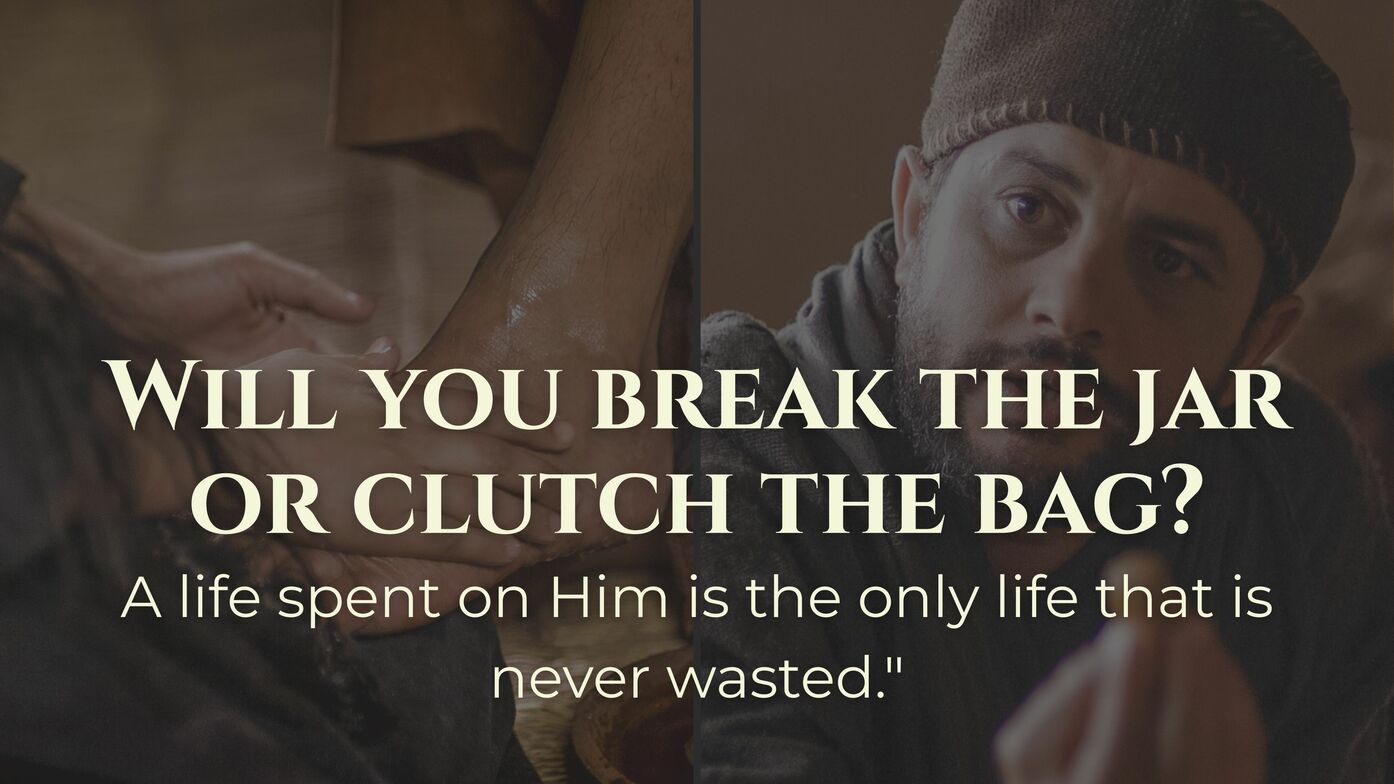
I've been thinking a lot about jars lately. And bags. Bear with me—I promise this is going somewhere.
Last Sunday, as I prepared to preach from John 12, I found myself sitting in my study, staring at that familiar passage about Mary and her alabaster jar of spikenard. I've read this story dozens of times. I've preached it before. But something about this moment—six days before Passover, Jesus walking deliberately toward the cross—hit me differently this time.
Maybe it's because I'm getting older. Maybe it's because I've watched too many people (myself included) try to follow Jesus while keeping one hand firmly gripped on their "safety nets." But as I studied this passage, I realized that John 12 isn't just a beautiful story about devotion. It's a crisis point. It's a spiritual audit. And it's asking us a question we'd rather not answer:
What is Jesus actually worth to you?
The Woman with the Jar
Picture the scene with me. It's a dinner party in Bethany, but the atmosphere is anything but ordinary. Lazarus is sitting at the table—yes, that Lazarus, the one who was dead four days ago. Jesus is there, fresh off a miracle that has the religious establishment plotting His murder. The air is thick with tension, with wonder, with the weight of what's coming.
And then Mary enters with a pound of spikenard.
Now, here's where we need to stop and do some math, because modern readers tend to gloss over the significance. This wasn't a nice gesture. This wasn't a thoughtful gift. This was a full year's wages for a common laborer. In today's economy, we're talking about $50,000 to $60,000 worth of perfume.
Her entire life savings. Her security. Her inheritance. Her backup plan.
And she broke it. All of it. Every drop poured out on Jesus's feet.
Then—and this is the part that gets me—she wiped His feet with her hair. In that culture, a woman's hair was her glory, her honor, her dignity. Mary didn't just sacrifice her treasure; she laid down her glory to honor His glory.
The house filled with the fragrance.
The Man with the Bag
But while the room was filling with that sweet aroma, someone else was doing calculations. Judas Iscariot—treasurer, disciple, thief—was outraged.
"Why wasn't this sold for three hundred pence and given to the poor?"
Now, if you didn't know better, you'd think Judas was the compassionate one in the room. He sounds righteous, doesn't he? He sounds like he cares about stewardship, about the poor, about responsible use of resources.
But John pulls back the curtain for us: "This he said, not that he cared for the poor; but because he was a thief, and had the bag, and bare what was put therein."
Judas didn't care about the poor. He cared about the bag. He was upset because he'd just lost an opportunity to steal from a major financial transaction.
Here's what haunts me about Judas: he said all the right things. He used spiritual language. He made a compelling argument. But his heart was rotten. He was sitting at dinner with the Son of God, watching a woman worship with reckless abandon, and all he could think about was money.
And here's what haunts me even more: I see Judas in myself more often than I'd like to admit.
The Question We're Avoiding
As a pastor, I've spent years counseling people, preaching sermons, and having honest conversations about faith. And I've noticed something: most of us have become experts at religious language. We know what to say. We know how to sound spiritual. We've mastered the art of looking devoted while keeping our real treasures safely locked away.
We talk about "stewardship" when we mean stinginess. We speak of "wisdom" when we mean unwillingness to obey. We claim to be "waiting on God" when we're actually just avoiding costly obedience.
Like Judas, we've learned to use good causes to justify holding back from total surrender.
And here's the uncomfortable truth I had to face as I prepared this sermon: every single one of us has a "jar" and a "bag" in our lives.
The jar represents what we could pour out for Jesus—our time, our talents, our treasure, our dreams, our reputation, our comfort. It's sitting there on the shelf, sealed tight, "just in case."
The bag represents what we're secretly clutching—the things we're protecting, the areas where we've told God "this far and no further," the sins we keep justifying, the comforts we refuse to surrender.
So let me ask you directly: What's in your jar? And more importantly, what's in your bag?
The Path to the Cross Demands a Decision
What strikes me most about John 12 is that Jesus's journey to Jerusalem forced everyone to make a choice. Look at what happened after this dinner party.
Crowds heard about Lazarus and came to see both him and Jesus. Many believed and followed. But the chief priests? They didn't just disagree with Jesus—they plotted to kill both Him and Lazarus. The same evidence produced completely opposite responses.
The Pharisees even admitted it: "Behold, the world is gone after him."
There was no middle ground. Nobody said, "Let me think about it and get back to you." The presence of Jesus—especially Jesus walking toward the cross—demands a verdict. You either go after Him or you go against Him.
And here's what I need you to hear: trying to stay neutral is itself a choice. Fence-sitting is not safety; it's rejection by another name.
Jesus said it plainly in Matthew 16:24: "If any man will come after me, let him deny himself, and take up his cross, and follow me."
Notice the order: deny yourself, take up your cross, follow. Not follow comfortably. Not follow conveniently. Follow sacrificially.
The cross wasn't a piece of jewelry for Jesus. It was an instrument of death. And He's telling us that following Him requires the death of our own agendas, our own control, our own self-interest.
What I'm Learning (the Hard Way)
I'll be honest with you—this passage convicted me deeply as I prepared to preach it. Because I realized that even as a pastor, even as someone who's given my life to ministry, I still have "jars" I haven't broken and "bags" I'm clutching.
There are areas where I've calculated the cost and decided it's too high. There are sacrifices I've avoided because I've convinced myself they're not "wise" or "practical." There are times I've used ministry itself as an excuse to protect my own comfort or reputation.
I've wanted a Savior who improves my life without demanding it.
But Mary shows me what true worship looks like: reckless, extravagant, costly. She didn't measure out a reasonable portion. She didn't keep a little back for emergencies. She broke the jar and poured it all out.
And Jesus defended her. While Judas criticized and calculated, Jesus said, "Let her alone." He validated her sacrifice. He connected it to His coming death. He recognized that she understood something the others missed.
She understood that the only appropriate response to a King who's about to give everything is to give everything in return.
The Fragrance That Remains
Here's what gives me hope in this story: the dinner ended, the guests went home, the three hundred pence was spent. But the fragrance remained.
Two thousand years later, we're still talking about what Mary did. Her act of worship echoes through history. Why? Because when you pour your life out for Jesus, it leaves a fragrance that doesn't fade.
You know what we don't remember? We don't remember what Judas kept in his bag. We don't remember what he stole or protected. We remember that he betrayed the King for thirty pieces of silver and died in shame.
Everything you hoard will be left behind. But what you sacrifice at Jesus's feet lasts forever.
So What Now?
If you've read this far, you're probably feeling what I felt as I studied this passage: uncomfortable. Convicted. Maybe a little defensive.
Good. That means the Holy Spirit is doing His work.
So let me ask you the questions I've been asking myself:
What is the most valuable thing in your life right now—and have you surrendered it to Jesus?
When was the last time your worship actually cost you something? When did your devotion last require you to give up a comfort, a grudge, a portion of your security, a piece of your reputation?
What spiritual language are you using to cover selfish motives?
Are you talking about "stewardship" while being stingy with God? Are you claiming to "wait on the Lord" while actually avoiding obedience? Are you using ministry, theology, or "wisdom" as a mask for self-interest?
Are you trying to follow Jesus while still clutching your money bag?
What are you protecting? What have you told God He can't touch? What area of your life have you declared off-limits?
Have you made your decision about Jesus, or are you still trying to stay neutral?
Remember: the fence isn't neutral ground. It's the wrong side.
My Challenge to You (and to Myself)
As we begin this new year, I'm challenging myself—and I'm challenging you—to live like Mary instead of Judas.
Find your jar. You know what it is. It's the thing you've been keeping "just in case." It's your backup plan, your safety net, your security that isn't really Jesus.
Break it.
Pour it out at His feet. Not a measured portion. Not a reasonable amount. All of it.
And then—this is important—don't sit there mourning what you've lost. Sit there breathing in the fragrance of what you've gained: intimacy with the King.
Because here's what I've learned after years of trying to follow Jesus: a life spent on Him is never wasted. But a life spent protecting yourself is already lost.
The path to the cross is narrow. You can't walk it while dragging your money bag behind you. You have to let go.
And yes, it will cost you everything.
But He's worth it. I promise you, He's worth it all.
What jar are you holding today? What bag are you clutching? I'd love to hear your thoughts in the comments. And if this post challenged you, please share it with someone who needs to hear it. We're all on this journey together, learning what it means to follow Jesus to the cross.